“Abba, why didn’t you move to Pakistan during the Partition?”
“Do you remember the tree in our backyard in Agra?”
“Yes.”
“We were very fond of it, especially your mother.”
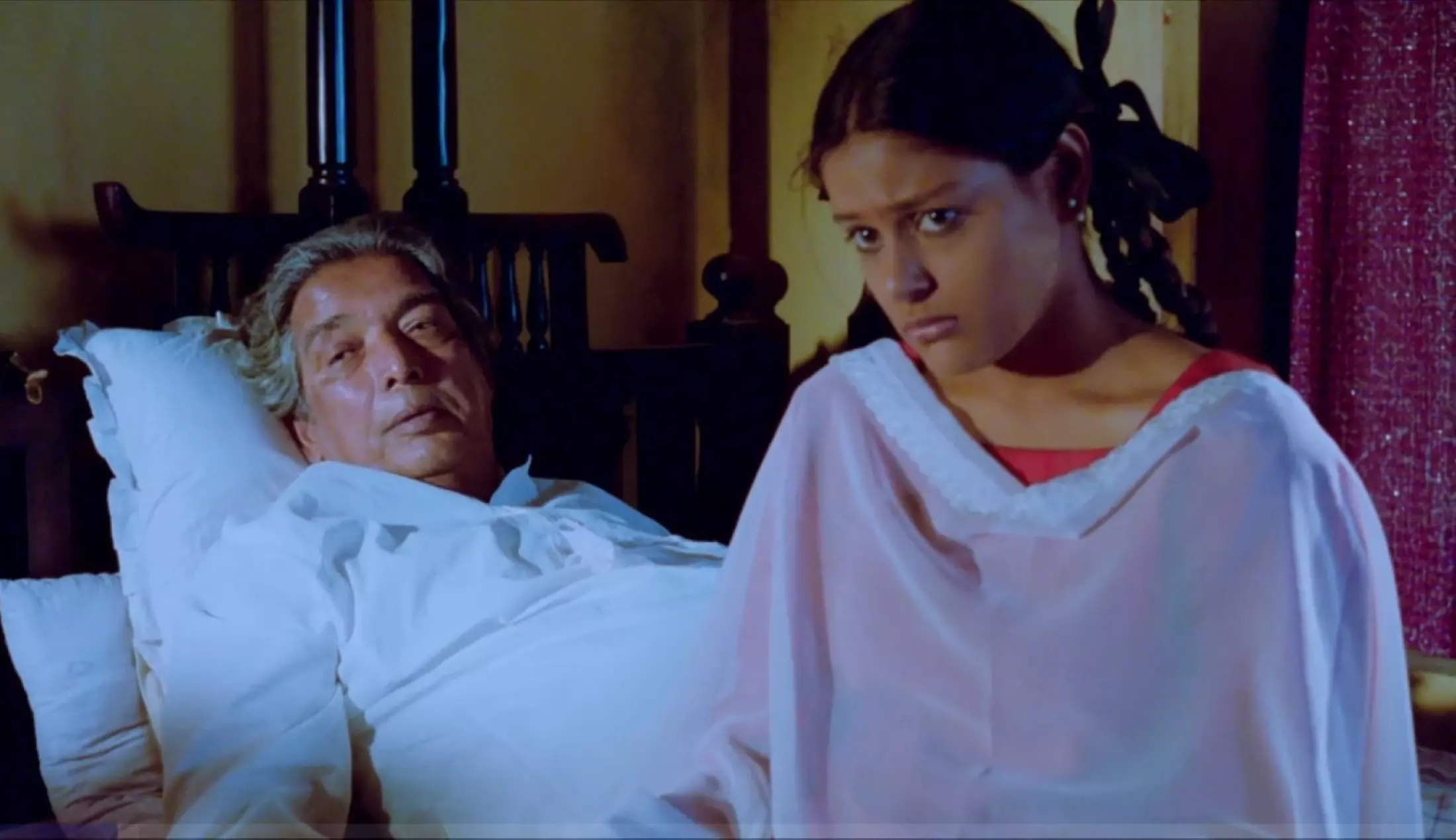
Thirty-one years after Saeed Akhtar Mirza’s Naseem (1995), the arrival of Imtiaz Ali’s Partition film Main Vaapas Aaunga (2026) forces a sudden, necessary return to this exchange. Set in the tumultuous days preceding the demolition of the Babri Masjid in December 1992, Mirza’s film constructs its narrative space almost entirely within a middle-class Bombay apartment, observing the tender relationship between a fifteen-year-old schoolgirl and her bedridden grandfather, played with monumental grace by the poet Kaifi Azmi. As the family watches the gathering communal storm brew across television screens and streets beyond the doorway, the grandfather’s voice becomes a vessel for fragile fragments of memory: recollections of an undivided Agra, of an imperiled secular promise, of a world on the threshold of violent reordering.
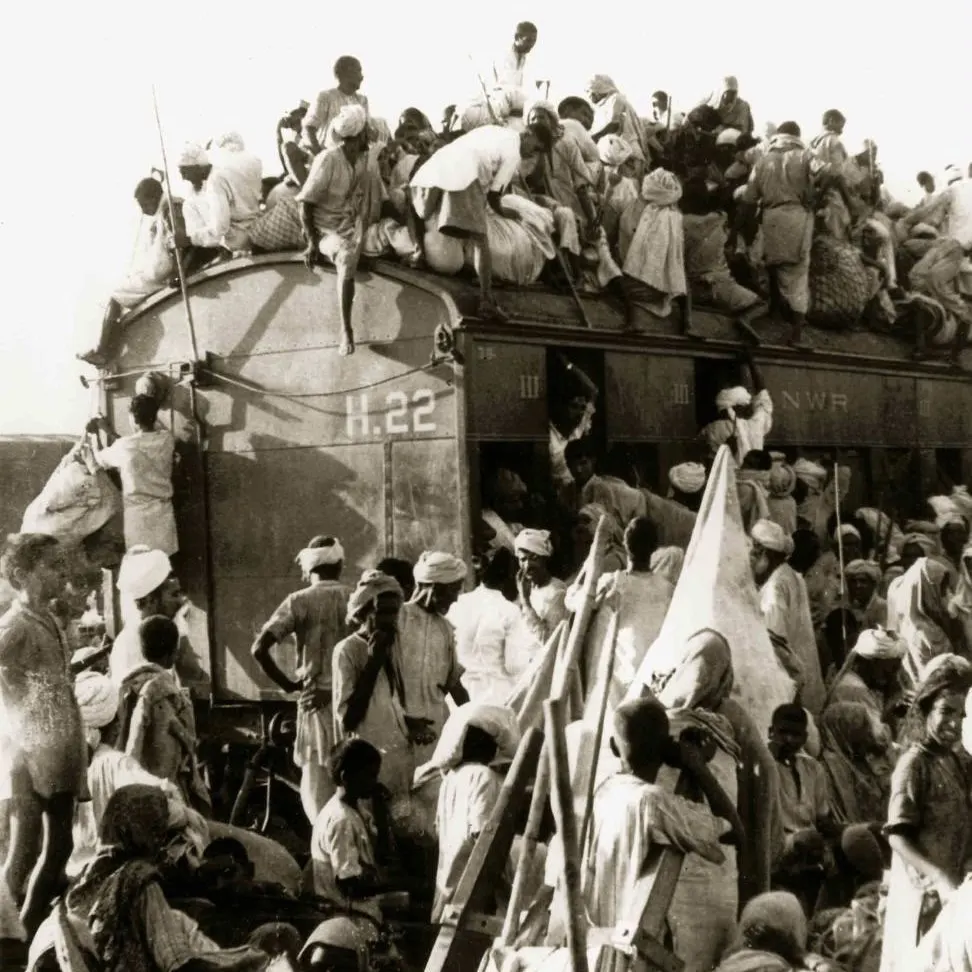
Naseem is technically not a Partition film; this brief reference to the backyard tree in Agra remains its sole explicit gesture toward 1947. Yet one wonders if an Indian film about Muslim interiority could ever not be a Partition film. And can any cinematic image of Punjab ever truly unmoor itself from the physical presence of the Radcliffe Line? Coupled with contemporary Bollywood’s majoritarian capture—where Pakistan functions as an essential, staged foreign threat against which Hindutva dramatises its promises of national prosperity—Indian cinema in 2026 seems particularly incapable of escaping Partition. This lingering pull reveals a striking asymmetry: where Indian cinema compulsively returns to 1947 to process present anxieties, Partition tends to be a finished origin story in Pakistani screen culture, an exceptionally horrifying one, whose violence can only be justified by never questioning its necessity.
…[O]ne wonders if an Indian film about Muslim interiority could ever not be a Partition film.
But what is explicitly recognised as Partition cinema remains a slim, fragile corpus, easily overshadowed by the sheer volume of written literature from India, Pakistan, and Bangladesh. As film scholar Bhaskar Sarkar observes in Mourning the Nation, early Indian cinema exhibited a prolonged formal hesitation toward 1947, a reluctance born of the unrepresentable scale of communal violence. Anthropologist Veena Das, charting survivor testimonials across 1947 and 1984 in Life and Words, traces this limited capacity to represent not to deliberate censorship, but to a fundamental breakdown of language itself: “...violence endured, or betrayals of which I was slowly to be made aware, seemed to be always on the edges of conversation.” For both Sarkar and Das, these silences and formal hesitations signalled the ongoingness of historical trauma, the past continuing its journey through the ordinary, domestic splintering of the present. Sarkar eventually turns to a “return of the repressed” to mark the moments when Partition trauma drew stark visualisation in Ritwik Ghatak’s films from the early 1960s and MS Sathyu’s Garam Hawa (1973), to name a few works, where violence transfers from allegory to the literal.
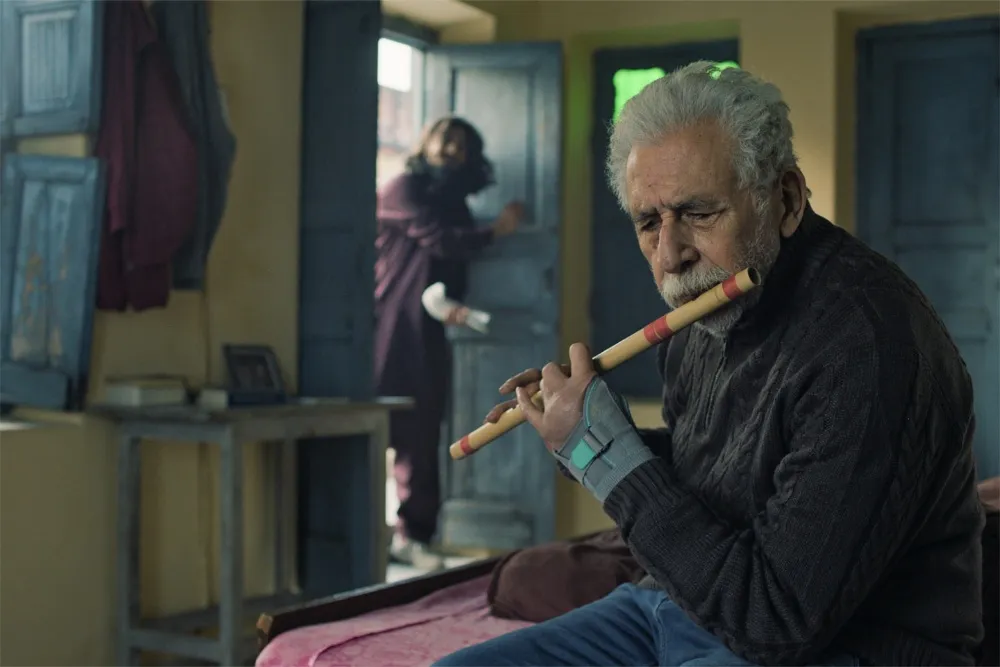
Main Vaapas Aaunga is acutely aware of this formal inheritance. The film finds its emotional anchor in ninety-five-year-old Ishar Singh Grewal (Naseeruddin Shah), whose late-stage dementia dissolves the linear present, marooning him in British India where he is an aspiring Urdu poet, equally in love with his Muslim classmate and his ancestral village in Sargodha. Moving between Ishar’s internal reveries and the present day, the film follows his disoriented kinship with his grandson Nirvair (Diljit Dosanjh), a struggling London-based stand-up comedian who undertakes a cross-border journey to deliver his grandfather closure by tracking down his lost love in Pakistan.
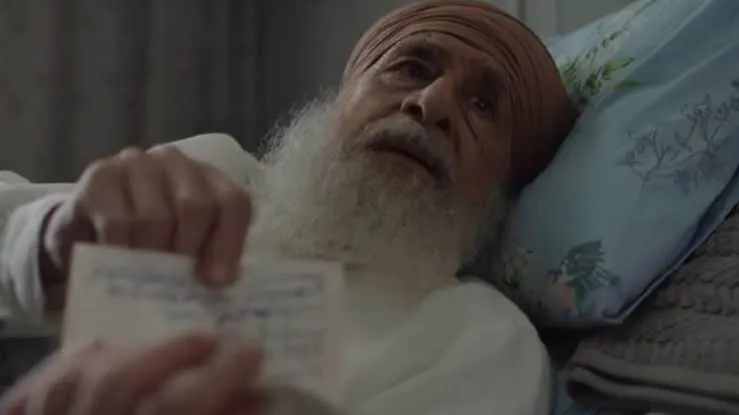
Main Vaapas Aaunga belongs to a welcome, if modest, wave of films attempting to counter Bollywood’s high-gloss commercial jingoism. Only months after its release, Gurvinder Singh’s Rehmat premiered at Locarno Film Festival. Also starring Naseeruddin Shah, now as Rashid Ali, a sick British national consumed by longing for his pre-Partition home, Rehmat operates through a cadence infused with silence and agrarian stillness. Adapted from short stories by Ajeet Cour, the film unfolds across three slow vignettes: a woman sheltering a Sikh militant named Balwinder; Balwinder’s family navigating his disappearance; and the family hosting Rashid as he searches for his father’s house.
[W]here Indian cinema compulsively returns to 1947 to process present anxieties, Partition tends to be a finished origin story in Pakistani screen culture, an exceptionally horrifying one, whose violence can only be justified by never questioning its necessity.
While Singh’s camera relies on duration, threshold space, and the physical weight of landscape, Imtiaz Ali’s direction is afflicted by sentimentalism and instruction. Ali avoids reconstructing communal violence beyond sporadic, if jarring, seconds of flashback. Yet Main Vaapas Aaunga remains an explicit tearjerker, when it is not burdened by awkward comedic interpolations via Dosanjh’s Nirvair and a strained attempt to convert Partition trauma into a therapeutic lesson for a modern protagonist fearful of commitment.
In its disregard for quotidian realism, Main Vaapas Aaunga shares common ground with Neeraj Ghaywan’s Homebound, favouring pedantic dialogue that explicitly seeks to educate its audience. We follow Nirvair as he browses Partition archives, tracks down his grandfather’s old acquaintances in Pakistan, and turns historical grief into material for his stand-up routines. This explanatory impulse signals a sharp departure in the on-screen staging of secular politics—a far cry from the easy ecumenism of Amar Akbar Anthony or Sholay’s lone cleric in an empty mosque.
If the Partition dynamic structures both Modi’s Bollywood and the liberal counter-films attempting to resist it, across the border the screen legacy of 1947 unfolds through a strikingly different spatial logic. Barring isolated works like Saifuddin Saif’s Kartar Singh (1959) or Raza Mir’s Lakhon Mein Ek (1967)—where the early post-independence border was still felt as an agonising, raw physical tear across contiguous Punjabi and Kashmiri landscapes—Pakistani screen culture has never experienced a comparable “return of the repressed” watershed. Instead, local media operates without needing Partition for its borders, treating it not as an open, living wound, but as a settled founding event whose initial sacrifices yielded a sovereign state.
This is not to say that nation-building ambitions do not propel the Pakistani establishment toward its own delirious propaganda. As political commentator Ayesha Siddiqa outlines in a recent piece for Himal Southasian, the Inter-Services Public Relations (ISPR) has steadily expanded from a military public-relations wing into a formidable machinery embroiled across several media industries in order to manufacture nationalist sentiment. If state imperatives are indeed an omnipresent force, how successful are the efforts driven by it in establishing a propagandist entertainment complex – beyond orchestrated photo-ops – or its counter by a few? Compared to India’s year in blockbuster films about war with Pakistan, Partition, and Punjab—Main Vaapas Aaunga, Rehmat, Border 2, Ikkis, Satluj, Dhurandhar: The Revenge—Pakistan’s year in hit television serials has continued its familiar soft propaganda, offering visions of a country organised around Muslims, families, and romances, structured primarily by uses and abuses of piety: Dar-e-Nijaat, Hurmat, Aap Ki Izzat, Gulbahar.
Within this lucrative television ecosystem, Partition arrives – when it rarely does – less as an interrogation of violence than as an exercise in nostalgic period reconstruction—an ambitious production requiring ensemble casts, elaborate costumes, and a stylised linguistic repertoire where accent, diction, and register do as much work as wardrobe in conjuring a vanished world. The form is familiar from Dastaan and Aangan. Yet the difficulty of bringing this history to television has itself been acknowledged by those who have attempted it.
Does the past possess any utility beyond signposting a museum?
“I was told that dramas based on the Partition are failures,” producer Momina Duraid said in 2015 about making Dastaan. “I agree that Partition plays are never easy, but I met people who told me that they made their daughters watch the drama to know about the sacrifices that led to this country.” Three years later, Duraid produced Aangan, another period drama about Partition, based on Khadija Mastoor’s 1962 novel of the same name.
Does the past possess any utility beyond signposting a museum? Twenty-three years on from its Golden Leopard win at Locarno, Sabiha Sumar’s Khamosh Pani continues to stand as a rare Partition film from Pakistan: a film that refuses heritage nostalgia to directly confront the afterlife of 1947 and the fractured foundations of the postcolonial state. Sumar’s cinema operates at the exact frequency where speech gives out, giving material weight and physical contour to the silences that hover around survivor testimony. Set in the Punjabi village of Charkhi in 1979—against the opening moves of General Zia-ul-Haq’s state-sponsored Islamisation drive—Khamosh Pani centres on Ayesha (Kirron Kher), a middle-aged widow whose quiet, daily routines of teaching the Quran to neighbourhood girls and fetching water from the village well are disrupted by the arrival of Sikh pilgrims. Among them is Jaswant, looking for his sister Veero, who in 1947 refused her father’s order to jump down the family well to preserve her honor during the massacres of Partition.
Ayesha, as we come to realise, is Veero. Having fled the well, she was captured, converted, and gradually absorbed into the village through marriage. But when her son Saleem (Aamir Ali Malik)—drawn into the fundamentalist fever sweeping Charkhi—discovers his mother’s non-Muslim origin, the village’s quiet consensus around her turns icy. Cast out from the community and disowned by the nation-state her long silence helped build, Ayesha walks alone to the well she evaded thirty-two years earlier, slipping without a sound into its dark, still water.
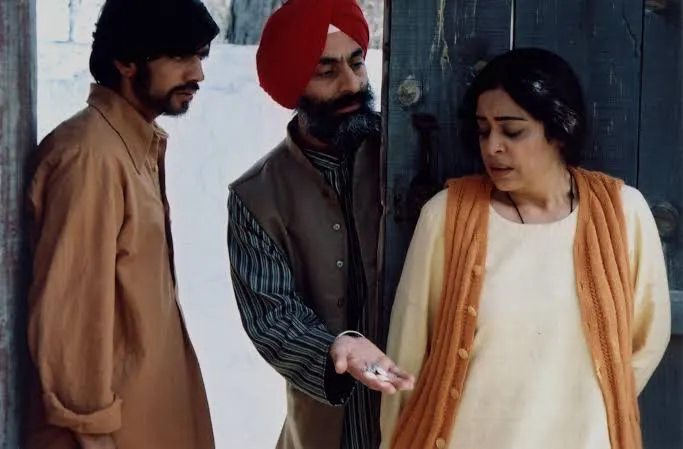
Unlike glossy television serials or big-budget Bollywood, Khamosh Pani places its faith entirely in the physical texture of the image and the unhurried duration of threshold spaces, much like the stillness of Rehmat. The camera sits patiently with the material surfaces of Charkhi: the rough, weathered stone lip of the well, the stagnant water below, narrow brick alleyways, and the dusty stretches between domestic courtyards and religious shrines. The well is neither a patriotic monument nor a picturesque prop; it functions as an acoustic abyss, holding the unspeakable history that official state narratives in both India and Pakistan try so hard to tidy up. When Ayesha steps into the water, Sumar refuses to frame it as tragic martyrdom or a neat history lesson. It registers instead as the crushing revelation that the spatial violence of 1947 never really ended and continues to permeate the present.

Manahil Tahira is a Karachi-based journalist and writer whose work moves between fiction and nonfiction, tracing the intersections of bodies, spaces, visuality and technology. Formerly desk head of Lifestyle at The Express Tribune, their creative writing has appeared in Arzu Anthology, Fahmidan Journal, Lakeer, and is forthcoming in The Aleph Review (2025). They are also a Non-Fiction Editor at South Asian Avant-Garde (SAAG) magazine.