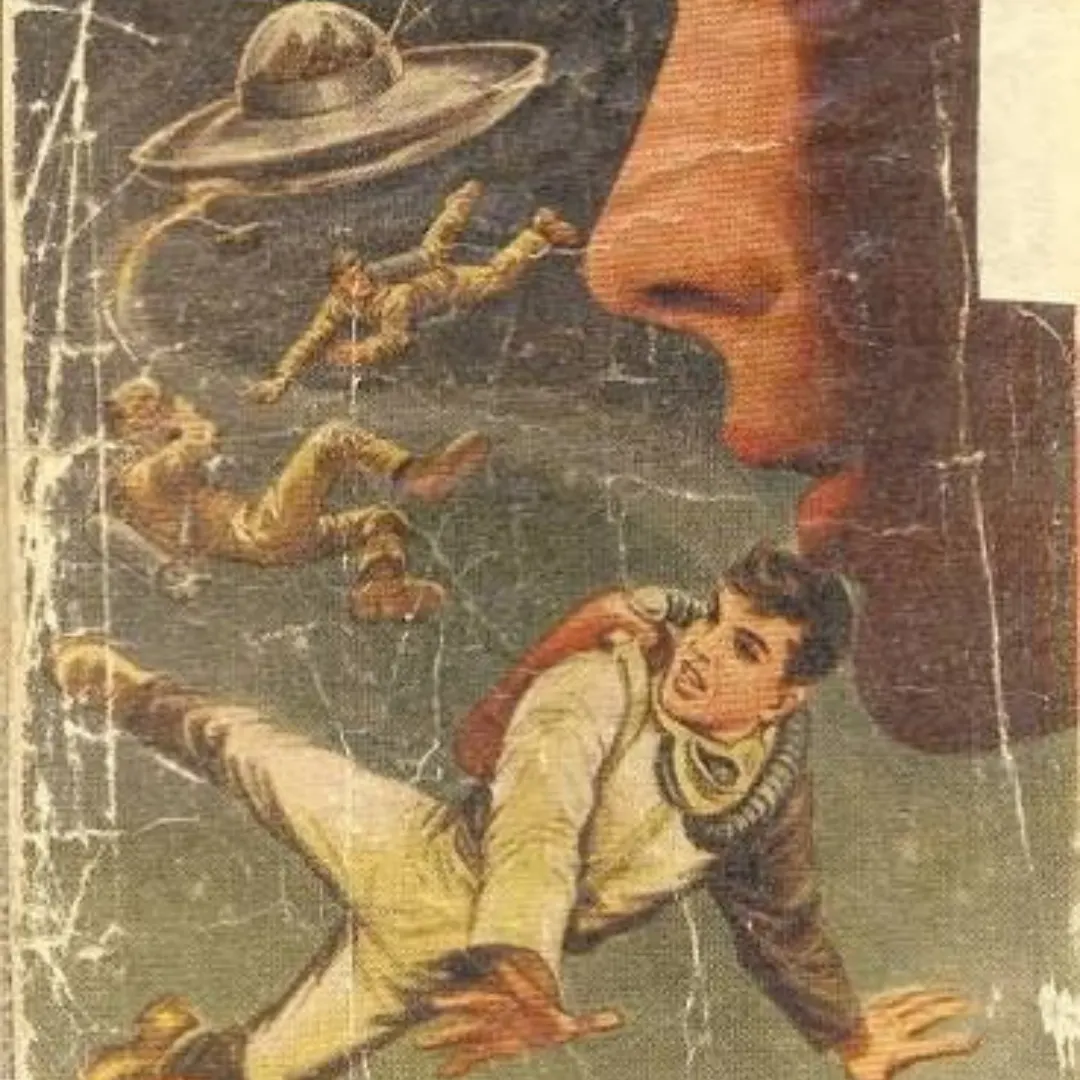
Pyāsā Samandar (The Devouring Sea, 1957), the 25th installment in Urdu jāsūsī writer Ibn-e-Safi’s (1928-1980) popular Imran series, begins with an encounter between a girl and an alien on a beach. The girl in question is Shimmi, the daughter of Dr. Dawar, the nation’s preeminent scientist in charge of its nuclear program. Dr. Dawar’s research facility by the sea is funded by the government, which has tasked him to explore the possibility of extracting atomic energy from the ocean. Walking along the beach one evening, Shimmi sees a mysterious girl hiding in the bushes—golden skinned, with ruby-red lips and glittering emerald eyes – who speaks in a strange melodious language that Shimmi is unable to decipher. The girl takes Shimmi to a clearing in the bushes, where there is “a huge metallic orb, with a diameter of nine or feet feet, with window-like openings all around it [bahut baṛā golā naẓar āyā, jo kisī dhāt kā thā aur us kā qaṭr nau yā das fuṭ se kisī ṭaraḥ kam nah hogā. Us main chāroṉ taraf khiṛkiyāṉ sī naẓar ārahī thīṉ!].” She tells Shimmi that she is from the planet Sparsaya and asks her to help her hide inside the research facility.
This seemingly otherworldly encounter sets the stage for Ibn-e-Safi’s sprawling plot, filled with international espionage, assasination attempts, and shadowy global powers—alongside a generous heaping of science fiction. Soon, Shimmi, Dr. Dawar, and the mysterious woman of gold are embroiled in a battle of wits for a mysterious and powerful substance that Dr. Dawar has discovered in the ocean—a substance that creates around itself a vacuum so powerful that it can destroy long-range ballistic missiles and other weaponry. They are aided, of course, by the eponymous hero of the series, Imran, codenamed X-2, an operative of their unnamed nation’s secret service.
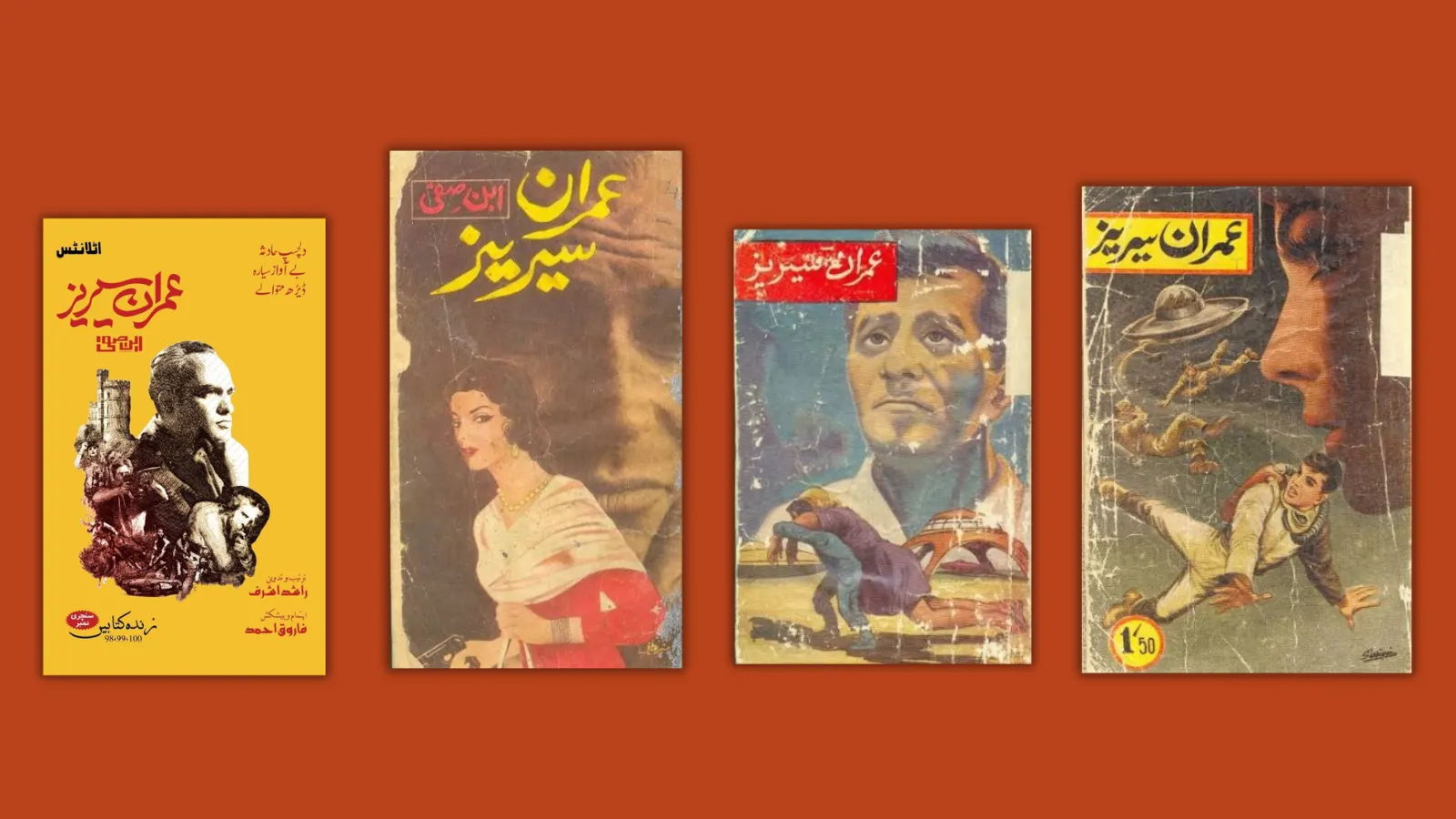
Imran, along with Colonel Faridi and Captain Hameed—characters of Ibn-e-Safi’s other popular jāsūsī novel series, Jāsūsī Dunyā—took over the mantle of Urdu-Hindi literature’s best ayyārs and jāsūs in the first half of the 20th century. But the world that the secret spy Imran, and the detectives Faridi and Hameed inherited was drastically different from their predecessors’: British colonial rule had ended in India, and Partition had led to the bloody creation of two independent countries. But the postcolonial nation-states of India and Pakistan did not just come into existence fully formed. They each had to be culturally imagined and politically achieved within specific historical conditions, with Pakistan having the additional challenge of having its Eastern and Western parts divided geographically, culturally, and linguistically. Globally, in the aftermath of World War II, the US and the Soviet Union (USSR) had emerged as the biggest geopolitical powers, drawing most newly decolonized countries into a decades-long protracted Cold War. Science and technology played a central role in the cultural production of the Cold War; nuclear bombs, satellites, computers, space wars, biological weapons, and much else loomed large in the global popular imagination.
Ibn-e-Safi’s jāsūsī fiction is an illustrative example of how the worlds of Urdu and Hindi popular literatures, in particular, did not yield completely to the logic of the nation-state, but found innovative ways to continue their circulation across both countries.
The borders of India and Pakistan had also disrupted and reshaped the worlds of Urdu and Hindi literatures—Urdu writers were divided across the borders, and Hindi and Urdu were increasingly drawn into nation-building ideologies in India and Pakistan, respectively. At the same time, these literary circles reconstituted themselves to fit into the constraints of the new context: writers from both sides continued to publish in each other’s magazines, and take part in important intellectual and literary debates. In fact, Ibn-e-Safi’s jāsūsī fiction is an illustrative example of how the worlds of Urdu and Hindi popular literatures, in particular, did not yield completely to the logic of the nation-state, but found innovative ways to continue their circulation across both countries. Ibn-e-Safi, born Asrar Ahmed near Allahabad (India) in 1928, had begun his writing career in the 1940s. While working as a teacher, Ibn-e-Safi also started an Urdu magazine called Nikhat in Allahabad with his friend, the progressive writer Ali Abbas Hussaini. He began writing poetry and humorous prose, including a parody of Ian Fleming’s James Bond titled “Thames Fond.” In 1952, he published the first installment of his jāsūsī novel series Jāsūsī Dunyā from Allahabad, before migrating to Karachi. In Karachi, he quickly set up his own publication house, Asrar Publications, where he continued publishing one novel a month for Jāsūsī Dunyā, as well as, from 1955, for his new Imran series.
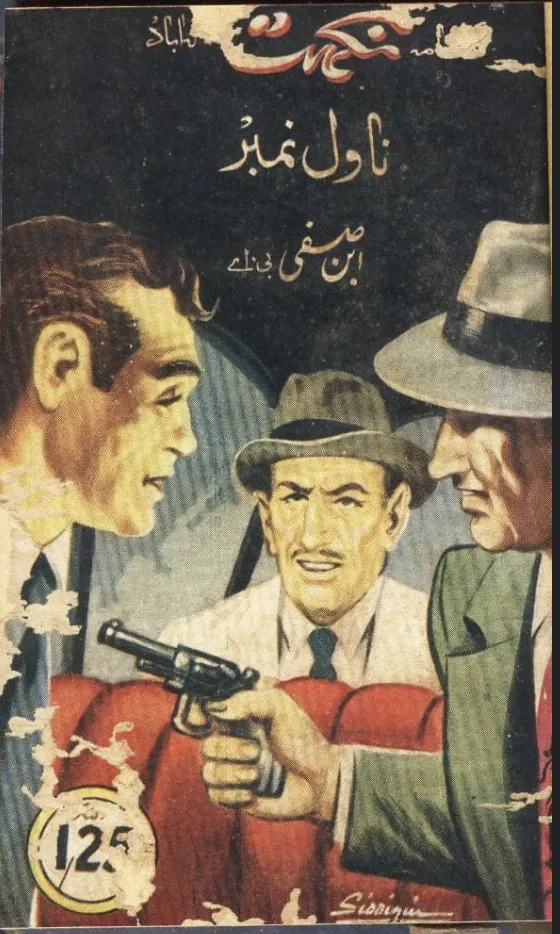
While his Karachi office (and later a Lahore office) published the novels catering to Pakistan’s readership, his friend in Allahabad continued to publish the same novels under the Nikhat publication imprint for Urdu readers in India. This was done not just in Urdu/Nastaliq, but also in Hindi/Nagari—Ibn-e-Safi’s novels were translated by Prem Prakash into Hindi by the same publishing house well into the 1960s. Through the Urdu and Hindi publications in India, his novels were then translated into other South Asian languages, such as Bengali and Gujarati. Interestingly, the only changes that were made to the Hindi versions were to some of the names—Imran became Rajesh, and Colonel Faridi became Colonel Vinod, Captain Hameed retained his name across both versions. The plots, the character beats, the mix of humor and intrigue, all remained the same. Ibn-e-Safi’s popularity, thus, was translingual and transnational. One reason that Ibn-e-Safi’s detectives and spies were equally beloved in both countries—which, after all, were not only often at war, but were on different sides in the global Cold War order—was that the world of his novels were general enough to be recognizable to both Indian and Pakistani readers. For example, Pyāsā Samandar takes places (like all of Ibn-e-Safi’s novels) in an unnamed modern city with offices, bungalows, cafes, clubs, and hotels, not to mention science labs and government departments such as the office of the Intelligence Bureau; streets often have colonial names (Queens Road, Bayly Road); characters belong to a range of nationalities, ethnicities, religions, and races, a mark of cosmopolitanism—Imran’s friends and fellow Secret Service operatives include Julia Fitzwater, Safdar, and Tanvir, and the world of espionage in the city includes the German Hoff Drake, the Eurasian James Flecker, and the Anglo-Burmese Roshi.
[T]he only changes that were made to the Hindi versions [of Ibn-e-Safi’s novels in India] were to some of the names—Imran became Rajesh, and Colonel Faridi became Colonel Vinod, Captain Hameed retained his name across both versions. The plots, the character beats, the mix of humor and intrigue, all remained the same.
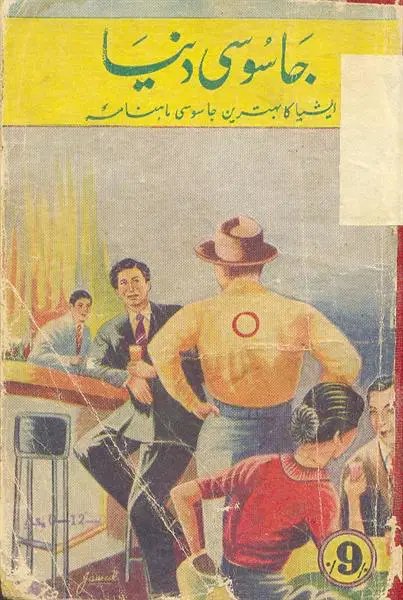
But even more than the cosmopolitanism of the setting and characters, the plots of these novels explored themes that would have been instantly recognizable to readers on both sides of the border. The crux of Pyāsā Samandar’s plot, for instance, hinges upon this unnamed postcolonial third world country’s ability to participate in the global arms race. The novel’s publication in 1957 came at a time when the US and the Soviet Union were in a fierce competition for supremacy in weapons technology like ballistic missiles and intelligence satellites. In fact, the same year in which Pyāsā Samandar was published saw the launch of the world’s first artificial satellite, Sputnik I, by the Soviet Union. India and Pakistan, too, were beginning to be drawn into the arms race. Just a year prior, the first nuclear reactor in India had been established. Thus, in the novel, Dr. Dawar’s appointment as the head of nuclear research by the government, tasked with figuring out how to develop nuclear power from the sea, was not outlandish science fiction so much as ripped straight from the headlines. At the same time, this technology was so new and wondrous that it was easy to imagine other, otherworldly possibilities. When Imran and his team are trying to figure out whether the golden woman is indeed from the planet Venus, as she claims, they debate whether or not she could be a robot instead. Imran thinks it is possible: “One can easily make plastic automata that feel like they are made of flesh and blood…it is not impossible in this age of machines, it must be some kind of mechanical invention! This is the age of artificial satellites, Black Zero! Could you have ever even imagined that one day human-made satellites would orbit the earth? [plāstik ke jitne putle kaho bana kar de sakta hun, woh tumhain gosht hī gosht mā’lūm honge…is mashinī daur main ye nā-mumkin nahī hai…who kisī qism kā mechanism hī rahā hogā! Ye masnū’ī sayyāroñ ka daur hai Black Zero! Kyā kabhī tumhāre weham main bhī thā ke ādmī ke banāe hue sayyāre zamīn ke gird chakar lagāeñ ge]?”
In addition to drawing on global technopolitics, the novel also articulates a sentiment that was particularly important to both nascent countries: that of patriotism and nation-building. Imran and his team of spies eventually discover that the “golden woman from outer space” was in fact an elaborate ruse by a shadowy global superpower called Zeroland, and the woman was Theresa Bumblebee of Bohemia, an operative sent by Zeroland to infiltrate Dr. Dawar’s research facility and steal the miraculous compound which can obliterate missiles. Imran’s role is to keep Dr. Dawar’s research safe for national security. Both characters describe their actions in the language of patriotism. Theresa says, “I have done nothing wrong. I work to serve my country…In the field of scientific advancement my country is far ahead of the rest of the world…Zeroland, which will one day rule the entire world, and all the most progressive countries in your knowledge will be as slaves to it [Mujhse koi kamīnā-pan sarzad nahī huā. Main apne mulk ke liyey kām kar rahī hun…Zeroland, jo ek din sārī dunyā per hukumat karegā aur tumhārī dānist main jo sab se zyāda taraqqī-pasand mumālik hain us se ghulām kehlānge].” Imran, too, expresses a similarly patriotic sentiment: “I would never want such a valuable asset of my country to fall into the hands of another [Main ye kabhī nahī chāhuñ gā ke mere mulk kā intehāī qīmtī sarmāya kisī dusre ke hāth lag jāe].” Intermingled with the outlandish twists and turns of the plot are real anxieties about both the strategic benefits and environmental and existential threats that such weapons technology pose. Dr. Dawar, when asked why he hadn’t yet given his research to his government despite knowing that it can be used as a defensive shield against ballistic missiles, says, “War is inevitable. No one can stop it. But it will not end the world. People will continue living in spite of the war. Then why destroy the environment permanently? [Jang zurūr hogi. Isse koi nahī rok saktā. Lekin is se dunyā nahī khatam ho sakegi. Log is jang ke bāwajūd bhī zinda rahenge. Phir humesha ke liye fiza kyun barbād kardī jae?].”
Science and technology played a central role in the cultural production of the Cold War; nuclear bombs, satellites, computers, space wars, biological weapons, and much else loomed large in the global popular imagination.
Ibn-e-Safi’s popularity was unmatched on both sides of the border and he wrote more than 120 novels in each of his two series until his death in 1980. At the same time, he was by no means the only popular jāsūsī writer to incorporate espionage, science, and Cold War geopolitics into pulpy, fast-faced novels in South Asia. In Urdu, writers such as Izhar Asar, Akram Allahabadi, and A. Hameed were writing popular novels that combined elements of jāsūsī, sāinsī, hairat-angez, and pur-asar in various permutations. In Hindi, the popularity of Ibn-e-Safi novels gave way to, in the 1970s, hard-boiled jāsūsī fiction by writers like Ved Prakash Sharma and Surendar Mohan Pathak. And around the same time that Ibn-e-Safi’s novels were making a splash in West Pakistan (and North India), another detective/spy thriller writer was doing the same in East Pakistan. This was Qazi Anwer Hussain, a Bengali writer who began publishing his immensely popular Masud Rana series from Sheba Prokashoni, his publishing house in Dhaka, in 1966. Borrowing from Western spy thrillers, most notably Ian Fleming’s James Bond series, Hussain adapted plots to suit East Pakistani sensibilities. In fact, with more than 430 novels in Bangla, Hussain’s series outlasted the demise of East Pakistan and the birth of Bangladesh in 1971, and is still ongoing. In the novels published between 1966 and 1971, Masud Rana, also known as Agent-9, works for the Pakistan Counter-Intelligence office (after 1971 he switches to the Bangladesh Counter-Intelligence office), and similar to Imran, is embroiled in international conspiracies surrounding science and technology against the backdrop of the Cold War.
[I]n the novel, Dr. Dawar’s appointment as the head of nuclear research by the government, tasked with figuring out how to develop nuclear power from the sea, was not outlandish science fiction so much as ripped straight from the headlines. At the same time, this technology was so new and wondrous that it was easy to imagine other, otherworldly possibilities.
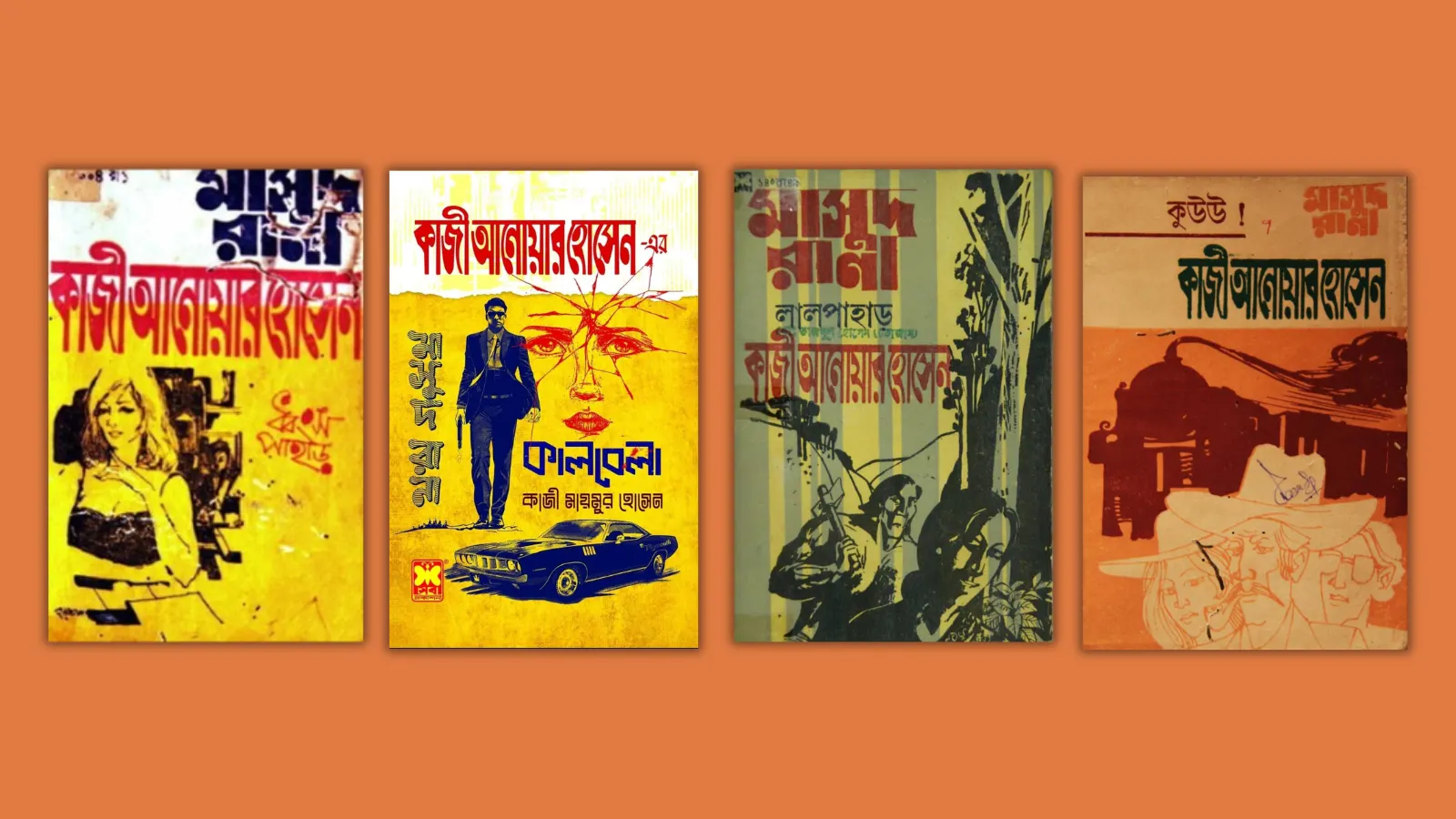
Hussain, unlike Ibn-e-Safi, did not fictionalize his settings and thus was able to tackle current global, regional, and national geopolitics more explicitly. As Projit Mukherji (2015) has shown, his first novel Dongsho Pahar [The Destroyed Hill, 1966] revolves around the Pakistani state’s efforts to build a massive hydroelectric power plant near Chittagong, and involves subterfuge by a scientist who is working for the Indian army. The second novel, Bharatnatyam (named after the classical dance-form, also published in 1966] follows a team of Indian spies disguised as a Bengali dance-troupe touring East Pakistan in order to release biologically modified locusts onto Pakistani’s agricultural fields to set off a famine. The Rana novels not only explore national and regional geopolitical tensions, but also, like Ibn-e-Safi’s novels, situate their events within a larger global imaginary, for instance by including Chinese spies to explore the important alliance that Pakistan had formed with China in the 1960s. In the fourth Rana novel Duhshahoshik [Fearless, 1967], the plot revolves around China’s attempts at making the nuclear bomb, which are being thwarted by a host of unnamed foreign powers who are making a local gang in Shanghai do their bidding by stealing China’s uranium. Rana and his team of Pakistani spies help their Chinese counterparts in their race to keep their hard-won uranium safe.
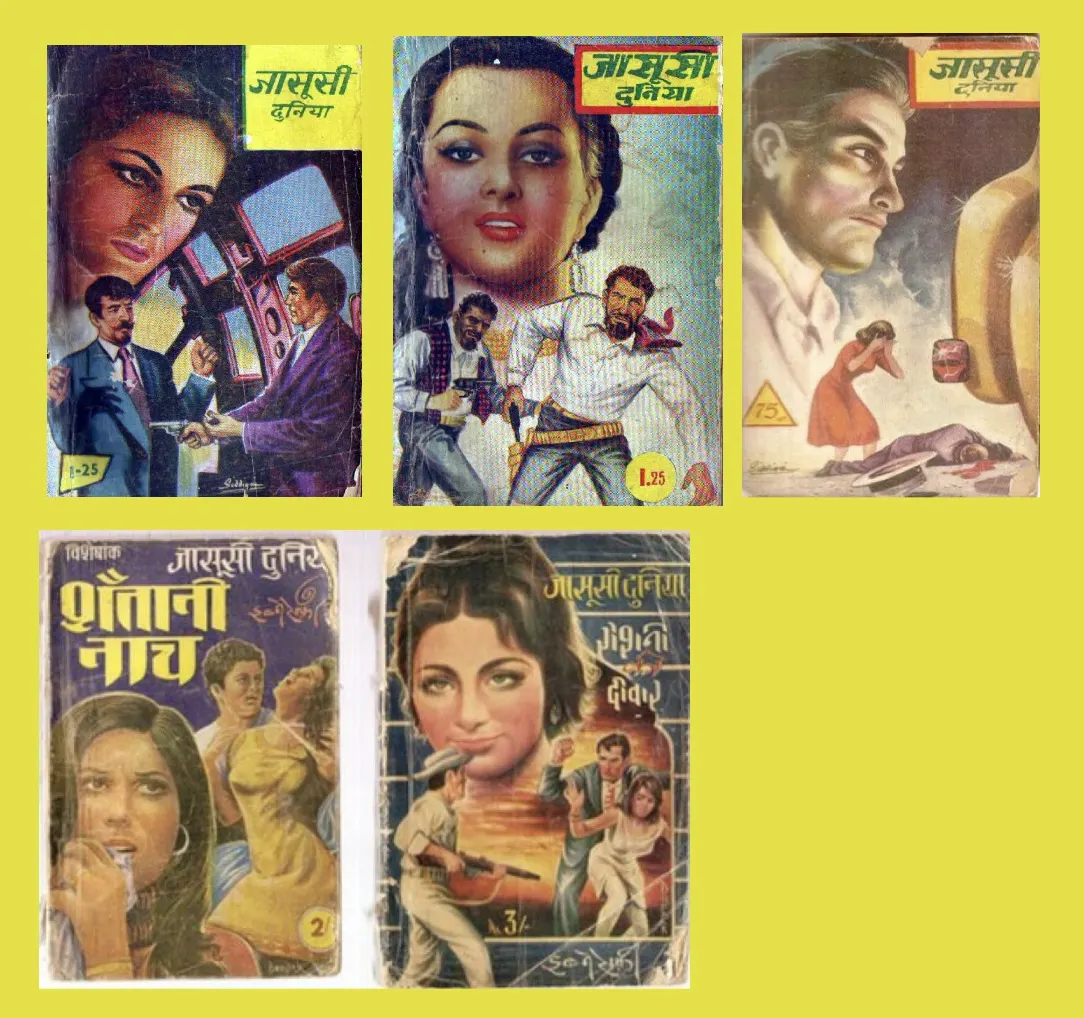
The postcolonial world of South Asian, and more specifically, Pakistani spy fiction, through its entertaining, fast-paced narratives that combined elements of action, science fiction, humor, and the occasional romance, is a fascinating window into what the Cold War politics of the time actually felt like to ordinary people. The colorful world of South Asian jāsūsī fiction, filled with spies, scientists, and government officials, reveals the excitement and fear of these newly formed postcolonial nations entering a world that was being reshaped by science and technology in unimaginable ways.

Nudrat Kamal is a PhD candidate of Comparative Literature at the University of Pennsylvania. Previously, she taught comparative literature and writing in Karachi. Her research and teaching focuses on South Asian literatures in Urdu, Hindi and English, particularly in the intersections of literary and print history, science fiction studies, gender and sexuality studies, and environmental humanities. Her writings on literature, film and television, and culture have been published in Dawn, The Express Tribune, and Newsline.