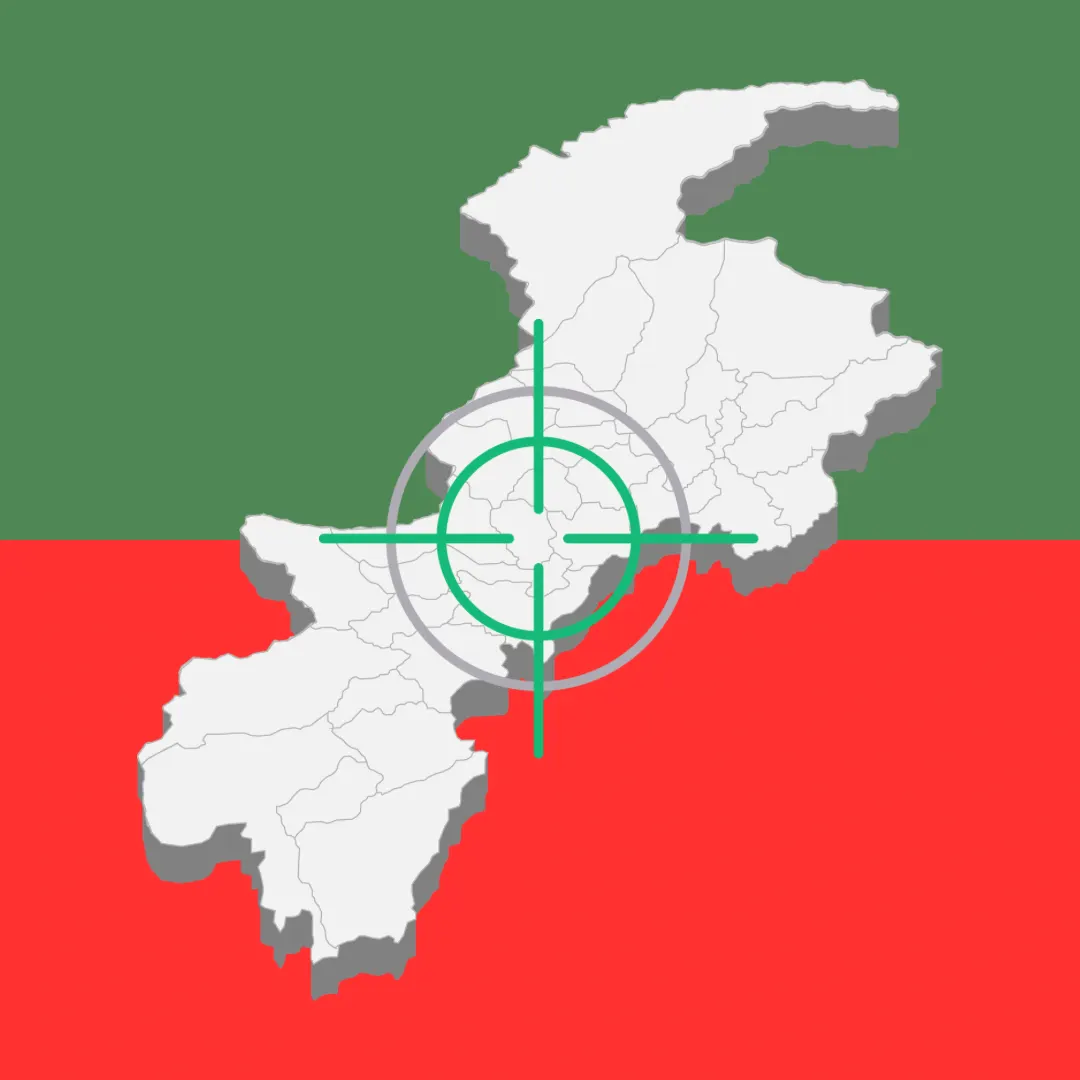
The imposition of governor’s rule in Khyber-Pakhtunkhwa was the 9th time a provincial government has been held in abeyance by the centre. 4 of those 9 times have been in this very province.
Pakistan’s history of centre-province relations is mostly a history of worsening conflict between different factions of the state and political elite. Sometimes it takes the shape of a centralist political party versus oppositional forces in the provinces. Other times it’s a reflection of the inherent tension between a military-bureaucratic apparatus and an oppositional civilian political executive. This latest episode, combined with the declaration of an emergency and the creation of a new governing structure in 12 southern and western districts, is of this latter category.
In its aftermath, people have been taken aback by the absence of a concerted street and agitational response to the sidelining of Afridi’s government. There were a series of spontaneous protests in Afridi’s home constituency in Khyber district, but other than that, the response to date remains muted. What explains this supposed acquiescence, despite what we know of the PTI’s popularity in the province?
At the outset, it’s easy to dismiss the least likely explanation – the assertion that PTI’s popularity in the province (or countrywide) has actually plummeted. This explanation is preferred by those partial to the regime at the centre for obvious reasons. However, it conflates the absence of action with evidence of waning appeal. The PTI is a political party and under standard institutional conditions, the most fundamental test of its appeal rests in the electoral domain.
Two former chief ministers and numerous forward blocs have attempted to carve the party out only to find themselves sidelined by the voters in favor of a fresh candidate slate carrying the PTI’s symbol. A third attempt will almost certainly yield the same result.
An election that is transparent to an even limited degree will simply reaffirm what most people know, which is that there is no political entity that can rival the PTI’s electoral hegemony in that province. Two former chief ministers and numerous forward blocs have attempted to carve the party out only to find themselves sidelined by the voters in favor of a fresh candidate slate carrying the PTI’s symbol. A third attempt will almost certainly yield the same result.
What does deserve more scrutiny is the condition of PTI as a political movement that can channel partisan sentiment out into jalsa grounds and on the streets. On that front, its viability has been weakened for now by a sequence of events, most of which were coercive in nature.
Protesting under authoritarian conditions places a far greater burden on movement leaders than under other, more permissive conditions. The PTI’s provincial leadership was almost immediately taken out of action through a series of ‘protective arrests’, limiting their contact with tiers further down in the party chain. On the ground reporting suggests the net has been widened to include second and third-tier leaders who did attempt to mobilize party cadres for the long march that preceded governor’s rule.
Secondly, the use of lethal violence to quell urban protest has been deployed to an arguably greater extent over the last few years than in the past. With it, the cost of protesting has gone up and the protection traditionally afforded by large numbers has dissipated. A large crowd offers a degree of protection against a baton charge, tear gas, or a water cannon, but not against live rounds. The memory of 26th November 2024 remains fresh for many, especially the cadre from Khyber-Pakhtunkhwa who were present in the largest numbers on that day.
Every time the centre’s ruling regime has deployed authoritarian overreach, some people proclaim that it is hastening its own demise….This analysis is both correct and flawed at the same time.
Third, the breakdown of relations within the party and across its support base on account of a communications gap with Imran Khan limits its ability to mobilize. The last few years have seen repeated accusations of treachery, self-aggrandizement, and betrayal levelled by the party’s core support base online (of whom many reside abroad) and its information ecosystem of grifting YouTubers and exiled ideologues against its parliamentary leadership. These accusations, in turn, have been weaponized by party leaders themselves in order to settle scores against rival factions.
Thus while the fog of war created by Khan’s incarceration has done nothing to dent partisan attachment and electoral appeal, and may have even increased it across the country, it has however considerably weakened its organizational form. In other words, the electoral arena will demonstrate one form of partisanship while the arena of mass mobilization will show its limits.
Is there a way back for the party via mass agitation? In the current moment, and with the current set of constraints, the odds are slim. Even if the party were to straighten out its internal issues, the broader political environment has changed in at least one very substantive way.
Every time the centre’s ruling regime has deployed authoritarian overreach, some people proclaim that it is hastening its own demise. That its high degree of unpopularity (evidenced by the 2024 election results and the continued electoral appeal of the opposition) is being papered over by coercive excess. That this is a regime that is fundamentally illegitimate in the eyes of the people and that will prove to be its undoing.
This analysis is both correct and flawed at the same time. It is correct that the regime is unpopular on standard metrics of popularity and that vast swathes of people deem it to be illegitimate. But the implication of this evidence changes when the definition of legitimacy is revised.
What if the governing logic at the centre – especially among the military establishment – is to disregard mass appeal or popularity among the electorate at large? What if the only appeal/popularity/legitimacy that matters is internal to the military-bureaucratic state apparatus, which can be secured by the distribution of privileges and by the advancement of geopolitical stature? And for those still unconvinced, what if pliable acquiescence can be guaranteed by the threat of punishment, even against those who may have retired? The reprisals and tightening of the last few years have now decisively changed mechanisms of control and acquiescence within the Pakistani state, and have consequently changed the limits of what is possible within mass politics.

Umair Javed teaches sociology at LUMS. Twitter: @umairjav