A single shard of sterilized white light in my eyes. Grey floaters clouding my vision, aimless and bereft. A plume of white vapor in my nose and then poof. I’m gone. White gives way to total darkness. I don’t get a chance to answer the nurse’s question, something about what I do and if I like—
…
The night before, I wonder if the surgery will work, if they will successfully excavate the endometriosis out of me. I take in the diagram the doctor’s team has made for me — a map of their game plan for going in, crisp and clean. Look, my fallopian tubes. My ovaries (two different shapes, like a pair of old breasts). The wobbly, ballpoint pen ligaments that connect to the uterus. Despite this visual aid, my internal, physical self is still distant to me, sharpened and brought into view only through the alive sensation of pain radiating through the right side of my body.
Lying in that grey hospital stretcher, I wonder if I’ll wake up tomorrow revised in some way — a better version of myself or a more contaminated one, maybe. But I can’t think about the future in any kind of clarified way for too long. Pain – its many, tiny kernels in the popcorn bag of my body – rattles away.
The cyst, huge as an apple now, consumes me. It is all I can dream about – so that I am encased inside it, like within a womb. I imagine the surgeon’s scalpel slicing into it in a days’ time, wringing it of life, whittling it down to seed and soggy, embryonic flesh. I imagine bite marks on an apple, how easily it browns and prunes when met with the outside world.
I wait patiently for this emptying. In the gynaecology ward, around me, women in other rooms push babies out.
….
Like the same outfit worn anew by whoever wears it, endometriosis can look different for everyone. What it is is endometrial lining sprouting in places it’s not meant to be. These places are usually imagined to be strictly in the reproductive area, but endometrial tissue can actually grow anywhere: the stomach, lungs, liver. One study investigated its wayward path to the brain. In its worst iteration, I imagine it lighting up the whole body like a Christmas tree on an MRI, all its nodes bright and flaring. This makes me think of weeds, their unchecked unruliness. How they make gardens swell and burst but render them entirely dysfunctional. How growth, generally considered a good thing, sprouts in all the wrong places.
Unlike what is generally understood, this is a systemic, whole-body attack. I feel endo’s strange stubbornness — a cellular overambition — coursing through my body, the pulsing way in which it knits and glues together my insides, threading itself into ugly permanence.
Susan Sontag describes cancer as a “demonic pregnancy.” Endometriosis can also feel similar. The abdomen certainly swells that way too, tender and inflamed. Clothes that normally fit well strain at the waist. The Thing inside of you feels real, as though it has its own sprawling, limitless life. Appetite changes. The body grows. Sometimes, it shrinks.
The everyday exhaustion, more than anything, is overwhelming — such that if you even tug at it ever so slightly, like at a lamp cord, fragmented sleep engulfs you within seconds.
Sontag also talks about illness as a “kind of interior decor of the body.” If endometriosis has any kind of furniture, it is strained and dull, weak and flattened. It weighs down the entire room. Disease is also often cited as a form of self-expression, or as a vehicle of excess feeling. If we take that to be true, I wonder what it is our bodies are trying to say. Have we rendered our bodies into pages? Are we enacting within our bodies what we would onto a blank canvas, willing ourselves to tell a story? And if indeed we are penning a story, should we not look at it in its entirety so as to ascertain the whole, collective one?
…
In a Pakistani study, at least 16.8% of women undergoing laparoscopic surgery were found to be diagnosed with endometriosis. This number is likely much higher in reality, because many women do not have access to adequate healthcare and because diagnosis can take up to 7-10 years – a lifetime in the face of pain. When I encounter strangers in my life — women at restaurants, at work, in the streets, and their soft, sometimes rounded bellies— I often wonder how many of them are afflicted, moving in this world with a mysterious, unnameable, gelatinous ache.
There are almost no endometriosis experts in Pakistan. Of the two most common endometriosis surgeries, namely ablation (where endometrial tissue is burned or cauterized) and excision (where the endometrial tissue is carefully, painstakingly removed), ablation is the most common within the country, even though it is now widely considered outdated in the rest of the world. Hormone therapy — the use of birth control pills without a break — is routinely prescribed. So is getting married and having children. While hormone therapy is simply a band-aid over a problem too complex to fix, surgery rarely – if ever – also promises permanent relief. The disease has a vengeful way of getting back up on its feet, like a reinvigorated wrestler in the last few minutes of a dramatic match.
…
When I flip through the photos on my phone, I see many portraits of my endometriosis. Constant documentation. Photos of bloat, of a body angled in various positions, of the many scans of ultrasounds. February, June, December. 2019, 2023, 2024, 2026. The years pass like flour through a sieve, the days accumulating around the jammy nucleus of endo.
[E]ndometrial tissue can actually grow anywhere: the stomach, lungs, liver. One study investigated its wayward path to the brain. In its worst iteration, I imagine it lighting up the whole body like a Christmas tree on an MRI, all its nodes bright and flaring.
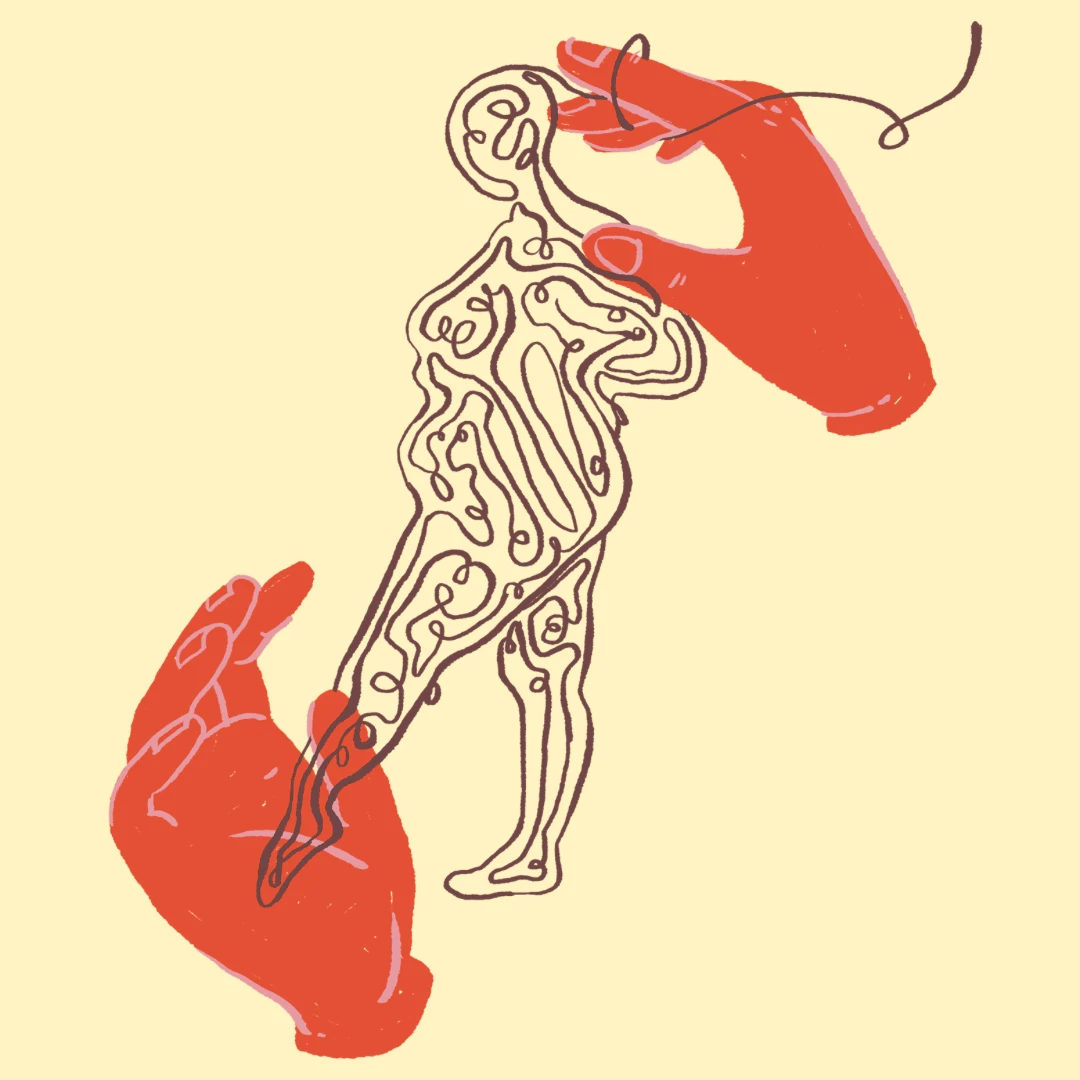
To have endometriosis is to be in such a complete state of transformation always, that even though every body is also always changing and evolving, the endo-body feels, because of the sheer acceleration of the rate at which it is growing what it is growing, like a page that is being written over, again and again. Occasionally, the surgeon too, can become an author in that story, shaping the body into something different, editing it like one would a manuscript. At random times in the day, I feel my ovary twisting into itself, spasms of electricity slicing through me, my body churning constantly, unnaturally, like a mind does. Like with my brain, I don’t know how to make it stop, its whims gargantuan and stubborn.
xxx
In her book The Body is Pain, Elaine Scurry repeats the refrain “to have pain is to have certainty, to hear about pain is to have doubt.” But there are times when the distance between the self and the other collapses and you yourself wield doubt like a weapon, looking at your reflection through a foggy, refractive glass instead of a clear mirror.
One becomes an unreliable narrator because for some reason, pain has to be present — blindingly in-the-moment — for it to be real, as concrete as a piece of nail or a follicle of hair. One of my favourite ways to track my period (after I read that one article about how tracker apps sell all your information to I’m not sure I remember who) is to just search up the word ‘period’ and ‘pain’ in my WhatsApp chats, and usually some barely intelligible, ominous message will pop up, one that I’ve sent to my mother or sister or best friend. ‘Just dying from period pain so can’t pick up.’ ‘m in immense period pain rn.’ A rarer one: ‘on period + really weird pain under my rib.’ I look at this pixelated proof, as distant and unreachable from me as the insides of my own body, to verify my own account. Yes, pain has touched me. Yes, it has changed my life. Yes, my period is right around the corner. (In the middle of writing this essay, I get my period. I laugh at my naïveté from a few days ago).
And then there is the risk of pathologizing the self to an extreme degree, obsessing over it. To listen to the story of your body in an attempt to understand the world but to not make a shrine out of it — how to maneuver this most delicate, impossible act?
To borrow a Didion phrase, always, large and looming in the background, there is “the question of self-pity.”
…
There are times when I am inattentive to my endometriosis and act like it does not exist. I don’t get regular ultrasounds, I ditch my vitamins, I am no longer found on endometriosis Reddit threads. In these times, life is beautiful. In the mountains, my friends and I eat cookies for my best friend's bachelorette, climb horses when the trek gets too difficult, take pictures of each other through a thin screen of green mist. When the film photos are finally developed, I am in bed, convulsing in cyclical pain. But the version of me in the photos is untouched and pure, as far away from pain as a newborn baby in its first nanosecond on Earth. I am happy to have that memory. Physical pain exiles you from your own life, but in the moments you return to it, your appreciation for the usual, otherwise unremarkable, terrain of that life grows tenfold.
…
When I talk to M – a designer based in Karachi – about her relationship to pain, she is matter-of-fact – or has now learned to be. “It’s also a vibration, just like joy,” she says. “When joy goes through your body, you don't like, stop and question joy. The invitation, I think, is to treat pain as any other energetic frequency.”
Over spearmint tea, M and I point to each other where our pain is, making diagonal slices with our hands near our hips, our back, our legs and ovaries. The location of our pain differs, as we expect it to. This disease is personalized, perfectly tailored for us.
“When you’re in so much pain, there’s a level of transcendence,” she continues. I nod in agreement, though I’m not sure I’ve personally transcended to anywhere yet. We are talking just outside her studio. A flare-up has caused her to postpone an exhibition.
[E]ndometriosis — and chronic illness at large — defies legibility. It has no real known rhyme, reason, or root cause. No neat resolution. Its invisibility can be mystifying, resisting words, resisting narrative arc. For such an active, aggressive illness, it presents with a kind of passive, puzzling inertia, containing no clear beginning, middle, end.
“Endometriosis is part of my life. But it is not my life. I used to suffer from migraines. That was just an experience. I love coffee. That is an experience. I sky-dove once. That was an experience.”
This is how I feel when I come across Hilary Mantel’s record of her endometriosis pain. She writes: “It stole my life: it stole it for ten years and for a double term, and then for ten years more.” But I read it and think, but this is life too. Mountain trek interspersed with agony near the sea spliced with the daunting skull of the MRI machine mixed with the coffee I grabbed with my sister right after the procedure was over. All of it is life, continues to be life, this whole collage of seemingly disparate things, stuck together like endo-affected organs.
…
It is after a period of such letting go — three years after my first surgery — that I find out my ovaries have regrown cysts, two sticky little gems, wet and drunk with blood. I throw myself into physical exercise. During my calisthenics lessons, I become obsessed with the crow pose (it takes me 8 months to be able to hold the pose for more than 10 seconds; in this time, the cyst in my right ovary grows from 3 cm to 5 to 7.) During my tennis lesson, the ball – plump and perfect – hurtles towards me. It is the same size as the sac my body is hell-bent on growing, humming inside me as I tie my shoelaces.
My body is revising itself, repeating itself once again. It doesn’t seem to need my permission to do anything. Choiceless, I surrender to its larger machinery, its unknowable and bloody industry.
…
The physical intensity of pain and then the acts we put on, the stories we narrate, the personas we try and inhabit — these two things exist together, like arteries and veins, carrying life to and from our own sense of personhood. Pain chips away at our sense of self, rewires and rewrites us, and to resist this theft, to build ourselves back up, we ascribe all kinds of meaning to it.
When I ask Y, a doctor and endometriosis patient, about when she figured out things were not normal with her periods, her story is characterized by a sense of toughness, one that bleeds into the conversation even now.
“And I was one of those people who, when I was younger – not anymore, but when I was younger – I used to think that pain is something of a challenge, something I cannot succumb to, so I wouldn't tell anybody,” she says through the Zoom screen, her voice steady and strong as a rope.
Each Pakistani endometriosis patient's life interacts with this disease in a distinct way; children, husbands, family, loneliness, community, hospital visits, the sharing and keeping close of your symptoms, the sense of victimhood but also the opposite, the sense of one’s own exaggerated strength — all of these puzzle pieces come together and make different shapes, different stories. They reveal gaps too: the places where the story doesn’t quite connect, the points at which the idea of our own strength collapses like a tent, the desires underneath left gaping and exposed.
In Y’s life’s story, she gets pregnant. The pain returns after she gives birth. She then goes on to have surgery for her endometriosis. They find endometrial deposits in many places, even on her diaphragm. “And after the surgery, he was like, why didn't you go to somebody earlier? And I said, I was being macho. Literally, that was all I could say, you know?”
Y’s worst fear in medical school – way before she even knew what endometriosis was – had always been to one day find out she had insufficient ovarian reserve. The reality and physicality of that truth now that she wants to give her child a sibling –but is unable to —hits her like a brick. The destroyed and disintegrated StrengthTent— the one we so painstakingly try to erect, over and over again— flaps in the face of large and vicious winds.
xxx
In The Pain Chronicles, Melanie Thernstorm writes: “Words (when given the power of belief) do affect pain – and words in combination with physical treatment can alleviate pain in ways better than either treatment alone.” The narrative around my sickness continues to change each day. Sickness has connotations, meanings, histories. It’s tempting to want to control the story that is spun from it and to believe that what I believe about it will matter in some significant way.
At the same time, endometriosis — and chronic illness at large — defies legibility. It has no real known rhyme, reason, or root cause. No neat resolution. Its invisibility can be mystifying, resisting words, resisting narrative arc. For such an active, aggressive illness, it presents with a kind of passive, puzzling inertia, containing no clear beginning, middle, end.
I want to believe the right, most correct and healthy thing about it, but whatever that thing might be continues to evade me.
“A person is a perpetual ongoingness perpetually mistaking itself for a still point,” writes Maria Popova. This is especially true for the chronically ill, because if there is one thing disease always does, it is that it progresses. It continues, long after the sentence articulating the diagnosis is over, after the pinprick of blood drawn, after the test result that signals deficiencies and excesses of the body at just one static moment in time is decoded. All attempts at story falter.
In one of my conversations with M, we laugh at what her mother-in-law has said about pregnancy: “If a woman leaves her uterus alone for too long it becomes a house of ghosts.” That is certainly one way to look at it.
…
To ground myself in my own physicality, I touch the four surgery incisions below my belly as reassurance. There may be more in the future; reluctant entry points into my body, talismans of a time I slept through but feel shaped by.
I keep telling myself that the work of being well and pretending to be well will converge sooner rather than later. But until I can diligently and routinely perform that work, act out that story, try and write it into existence, there’s no real and true way to know. Just like in writing this piece, the work is in the doing.
…
On another phone call: M and I veer into a discussion about the terror of AI, how it seems to have numbed our thinking, our intelligence. In this way, it reminds me of the flattening, stupefying effect of hormonal birth control pills, how those tiny moons inject all my days with an unnatural non-feeling, non-specificity.
But then the consolation: the machine doesn’t exist in the real world, can’t know, experience, or record pain — its clarifying, all-consuming, hypnotic pulse. How illuminative it can be. The curiosity it engenders. In this, I begin to see pain’s value, its reluctant gift.
Manal Ahmed is a writer from Karachi and a current Oxford Pakistan Programme scholar in World Literature. She has previously been published in Dawn, F(r)iction, and the Express Tribune.